01
20+ years of
clinical observation

The insight did not arrive in a flash. It accumulated — patient by patient, session by session — as Dr. Jain watched the gap between excellent cancer treatment and the human experience of receiving it.

02
A deep dive into the
science of HRV

Heart rate variability had been validated in cardiovascular medicine, stress research, and oncology fatigue studies. The science was established. What was missing was someone to apply it here, in this context, in real time.

03
Building — a closed-loop
therapy device

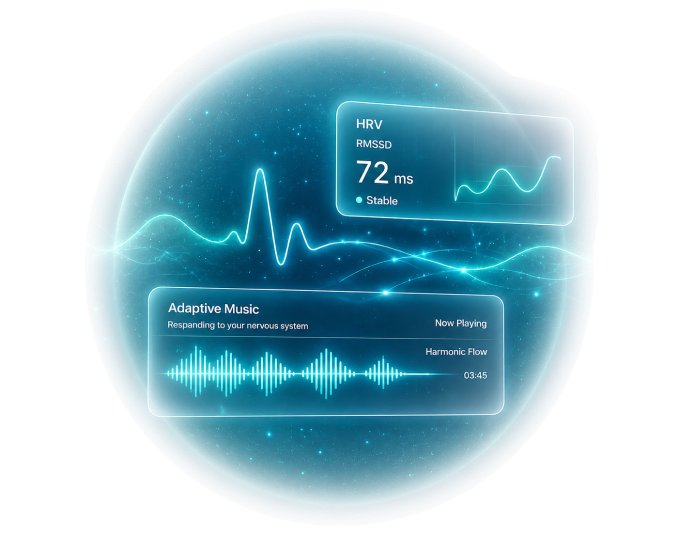
Device reads HRV continuously during treatment. When the nervous system shows distress, the music adapts — shifting toward grounding or calming compositions. No drugs. No instructions to the patient. Just a body, listened to, and responded to.

04
Building Skitii — a closed-
loop therapy device

A 70-patient randomised controlled trial at Yenepoya Medical College — head and neck cancer patients, undergoing radiotherapy and chemotherapy — is now measuring whether the idea holds. Dr. Jain has designed it to give an honest answer, whatever that answer may be.

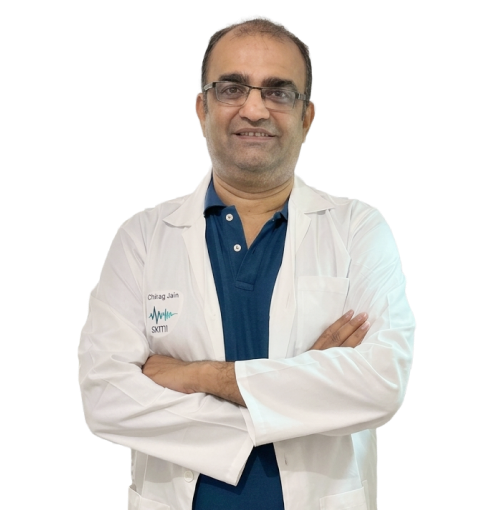
Dr Chirag Jain
Dr Chirag Jain in clinical practice

There is a kind of
suffering medicine

has learned to look past.

Dr. Chirag Jain has spent over 20+ years with patients — close enough to see what a scan cannot show and a chart cannot record. The fear that arrives the night before chemotherapy. The quiet dread that fills a radiation room.

The way anxiety, left unaddressed, compounds
every other burden a cancer patient carries.

0+
Years in
Clinical Practice
0
Patents
Granted
0
Patient RCT
Underway
0
Countries ·
PCT Filing
Awards icon
Awards

Jewel of India
Star of Asia

Speaker icon
Speaker
CNBC
Where it began

The question he
couldn't stop asking

Oncology is extraordinary at keeping people alive. But Dr. Jain kept noticing something no protocol addressed — the fear patients carried silently through every treatment session. Heart rate rising. Muscles tense. Mind overwhelmed. And then returning the next day to do it all again.

That led to a simple question: what is the patient feeling, right now, in real time — and can we respond to it? That question became the foundation of Skitii and Dr. Jain’s work in adaptive music therapy.

Dr Chirag Jain with a patient in a clinical setting

What he observed

The silence nobody
talks about

Most oncology consultations last minutes. The room between sessions — the waiting, the anticipating, the sitting alone in the treatment chair — lasts hours. Anxiety lives in that room.

The dropout no
one tracks

Patients abandon treatment mid-course — not always because of the physical side effects, but because the emotional weight becomes unbearable. This is a clinical failure that anxiety data never fully captures.

The body's signal
nobody read

Heart rate variability — a well-established medical marker of the nervous system's stress state — was being measured in cardiac units and research labs. But no one was using it in the oncology chair. In real time. For the patient sitting there right now.

What was
on offer

A counsellor once a week, if available. Generic playlists. Meditation apps designed for healthy adults. None of it responded to what the patient's body was doing in this moment.

We had built extraordinary machines to treat the tumour. But in that chair, with the machine humming, the patient was completely alone with their fear.

— Dr. Chirag Jain
Dr. Chirag JainDr. Chirag Jain
The insight

Anxiety is not just a feeling.
It is a
physiology.

This is where Dr. Jain's thinking shifted. Anxiety during cancer treatment is not simply psychological — it is a nervous system event. It shows up in cortisol levels, in heart rhythm, in the measurable suppression of the body's parasympathetic activity. The body is broadcasting its distress, continuously, in data.

If the body was speaking — in the form of heart rate variability, in the rhythm between each heartbeat — why wasn't anyone listening? And more importantly: if you could hear it, could you respond to it? Not with a drug. Not with a script. But with something that moves with the patient, adapts to them, and asks nothing of them except to simply receive it.

That is when Dr. Jain arrived at music — not as a pleasant distraction, but as a physiological intervention. One that could be guided by the body's own signals. One that could adapt in real time. One without side effects, without language barriers, without adding a single milligram to an already heavy treatment burden.

Illustration representing anxiety as a physiological signal

The nervous system
is measurable

Heart Rate Variability — specifically RMSSD — is medicine's validated window into autonomic stress. When anxiety peaks, RMSSD drops. When the nervous system calms, RMSSD rises. It is a continuous, honest signal from the body.

Music is a real
physiological input

Music activates the autonomic nervous system. It slows respiration. It shifts heart rhythm. It is not metaphorical. Decades of research show measurable physiological changes from music — specifically instrumental music, which bypasses the cognitive load of language.

The loop had never
been closed

Nobody had built a system that reads HRV in real time and uses it to drive the music selection — creating a closed physiological loop. Read the body. Respond with music. Watch the body change. Adapt again. Dr. Jain decided to build it.

From observation to invention

How a clinician
becomes an inventor

This is where Dr. Jain's thinking shifted. Anxiety during cancer treatment is not simply psychological — it is a nervous system event. It shows up in cortisol levels, in heart rhythm, in the measurable suppression of the body's parasympathetic activity. The body is broadcasting its distress, continuously, in data.

If the body was speaking — in the form of heart rate variability, in the rhythm between each heartbeat — why wasn't anyone listening? And more importantly: if you could hear it, could you respond to it? Not with a drug. Not with a script. But with something that moves with the patient, adapts to them, and asks nothing of them except to simply receive it.

That is when Dr. Jain arrived at music — not as a pleasant distraction, but as a physiological intervention. One that could be guided by the body's own signals. One that could adapt in real time. One without side effects, without language barriers, without adding a single milligram to an already heavy treatment burden.

Dr Chirag Jain

Philosophy

What he believes
about how patients
heal

After 20+ years in clinical practice, Dr. Jain has arrived at a set of convictions that shape everything he does — in the clinic, in the research, and in the work he is building.

01

The mind and body
are not separate in
the treatment chair

Every moment of anxiety during cancer treatment has a physiological signature. Cortisol rises. The nervous system tilts toward threat. Recovery slows. Treating the tumour without treating the fear is treating half the patient.

Music is medicine —
if you use it like medicine

A playlist is not therapy. Therapy is adaptive, responsive, personalised. Music earns its place in oncology care only when it is guided by what the patient's body is actually doing — not by what we assume they would enjoy.

Compassion without
rigour is not enough

Every doctor who has sat with a frightened patient has wanted to do more. Dr. Jain's belief is that wanting is not sufficient — that the care owed to these patients demands clinical validation, regulatory scrutiny, and peer review.

04

Real-time response
changes everything

A weekly counsellor session cannot respond to what the patient is feeling at minute seven of a radiation session. Real-time intervention — continuous, non-intrusive, adaptive — is fundamentally different from anything that has come before it.

The work in progress

Testing the idea
the hard way

Dr. Jain is not asking anyone to try or believe in the device on faith. He has designed multiple randomised controlled trials across different cancer etiologies — the gold standard of clinical evidence — and in one of the trials at Mangalore, enrolled 70 head and neck cancer patients.

Half receive the device's adaptive music therapy. Half receive static music. Both groups are measured — anxiety, depression, quality of life, and HRV parameters. The primary question is whether the adaptive system meaningfully reduces anxiety over three weeks of treatment.

He will publish the results regardless of the outcome. That is a commitment to the science, not the product. If it doesn't work, the world should know that too.

30%
of all cancersin India

The clinical gap he
is addressing

Head and neck cancers represent 30% of all cancers in India.

Treatment is aggressive - radiotherapy, chemotherapy, or both. And 65-85% of these patients will experience significant anxiety and depression during that treatment.

What the
trial measures

HADS anxiety scores (at 3 weeks)
RMSSD values (during sessions)
Treatment adherence
Quality of life

The design isolates one variable: does the HRV-driven adaptive algorithm make a measurable difference?

What rigour
looks like

Device validated against gold-standard Kubios HRV analysis before patient enrollment.

Open science commitment - protocol published, results shared regardless of outcome.
Link

Intellectual work, formally recognised

Method of Identification of Distractions for Study or Work Friendly Environment

Granted · 563614

Method for Monitoring the Focus State of an Individual in Real Time

Granted · 558041

System and Method for AI-Based Adaptive Emotion Regulation

Filed · PCT
Connect

If this work
speaks to something
you
care about

Dr. Jain is not looking to pitch. He is looking for people -
oncologists, researchers, hospital leaders, collaborators - who
are troubled by the same gap he has spent 20+ years thinking
about. If that is you, he would like to talk.

Connect on linkedin
Connect on instagram
Mumbai, India